
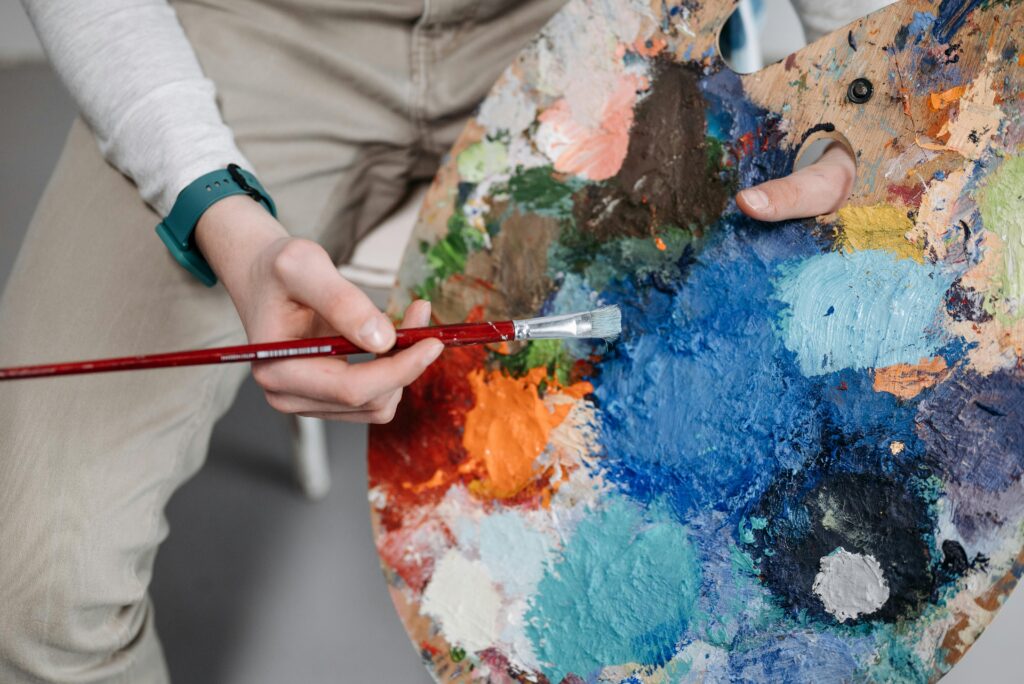
There’s a scene a lot of people recognize. You finish the day exhausted – but not the kind of tired that disappears after a good night’s sleep. It’s a fatigue that builds. Meetings, notifications, small decisions stacked on top of big ones. And then, at some point during the week, you spend a few hours doing something that doesn’t really serve a purpose: trying a new recipe, sketching in a notebook, playing a song no one will hear. And you come out the other side feeling different.
What happens in that gap?
Stress Has Become the Default
It’s not just a feeling. The numbers confirm what the body already knows. According to the American Psychiatric Association, 43% of American adults said they felt more anxious in 2024 than the year before – a sharp increase from 37% in 2023 and 32% in 2022. The trend is accelerating. In the workplace, a NAMI survey of full-time workers found that 52% reported experiencing burnout in the past year due to work, and 37% said they felt so overwhelmed it was affecting their ability to do their jobs.
The standard response to this usually follows a familiar script: more productivity systems, meditation apps, time-management spreadsheets. These tools have value. But they often treat the symptom while the root problem continues. What’s missing, in many cases, isn’t better organization. It’s a different quality of presence.
What Happens in the Brain When You Create
Scientists have begun studying the effects of creative activities on the nervous system more rigorously – and the results are consistent. In one widely cited study, just 45 minutes of art-making significantly reduced cortisol levels (the body’s primary stress hormone), regardless of the participants’ skill level. A broad review of arts-based interventions found that more than 80% reported reductions in stress.
The World Health Organization has recognized engagement with artistic activities as a meaningful contributor to mental health promotion and disease prevention.
Why does this work? Creating engages neural networks that are different from those driving analytical work and constant decision-making. You enter a state of focused attention – but without the pressure of producing an outcome. Psychologist Mihaly Csikszentmihalyi called this “flow”: a state of immersion in which the sense of time dissolves and self-consciousness fades. It’s not passive relaxation. It’s a different kind of engagement – one that rests what normally works overtime and activates what normally stays quiet.
Yayoi Kusama and Art as a Lifeline
Few examples in art history illustrate the relationship between creativity and psychological survival as directly as Yayoi Kusama. The Japanese artist – now in her 90s and considered one of the most influential living artists in the world – has lived with hallucinations, obsessive-compulsive behaviors, and severe anxiety since childhood.
From an early age, Kusama turned her visions into images: the dots multiplying to infinity, the nets covering everything around her, the patterns she saw in flowers and river stones near her home. Rather than being consumed by these experiences, she transferred them onto canvas. “I would cover a canvas with nets” she wrote in her autobiography, continuing until the table, the floor, and finally her own body were covered. She described art as the only method she found to relieve the pain, anxiety, and fear she fought every day.
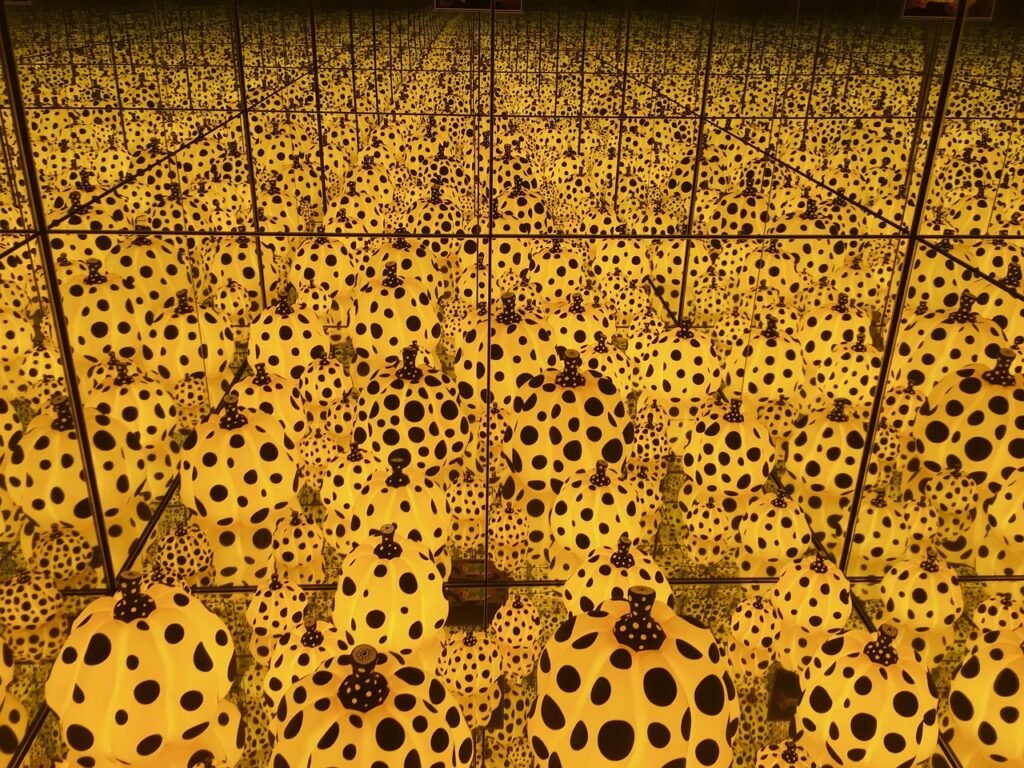
Kusama didn’t become an artist in spite of her condition. She found in the act of creating a way to inhabit it without being destroyed by it. Her story isn’t one of using art to cure a problem. It’s one of using art to keep existing, with clarity, inside a problem that had no simple solution.
This isn’t an anomaly among creators. It’s a recurring pattern throughout the history of art and literature. What changes in the contemporary context is that this tool no longer needs to be reserved for professional artists.
Creativity Doesn’t Require Talent
Here’s the biggest obstacle: most people dismiss creative activities with “I’m not good at that.” And that dismissal has a specific origin. Modern culture separated the act of creating from the process of creating and turned making into performing. Learning to play an instrument became synonymous with playing well. Drawing became synonymous with drawing beautifully. The result is that we abandon the activity before discovering what it might offer.
Research points in the opposite direction. The cortisol reduction observed in studies occurs regardless of skill level. Structured, repetitive activities — like coloring patterns or drawing mandalas – have been shown to reduce anxiety. What matters isn’t the final product. It’s the process: present attention, immediate feedback, and the absence of external judgment.
Which Creative Activities Work – and Why
There’s no definitive list. What effective activities share in common is more interesting than any label.
Journaling and free writing give shape to thoughts that were circulating without form. Drawing and painting offer visual attention that quiets mental noise. Playing or composing music demands full presence. Gardening combines light physical activity with visible results and natural cycles that operate entirely outside human productivity logic. Cooking, ceramics, knitting, and crocheting lean into manual repetition – which, as Kusama demonstrated for decades, has a genuinely regulatory effect on the nervous system.
What connects all of them is straightforward: you are doing something with your hands and your attention, in the present moment, without a success metric imposed by someone else. It’s the direct opposite of the logic that generates burnout.
How to Add This Without Making It Another Obligation
There’s a specific trap for people living inside an optimization culture: turning creative rest into a goal. You start painting to unwind, and within three weeks you’re comparing your progress to YouTube tutorials, buying supplies you’ll never use, and feeling guilty for not making anything in the past two weeks.
Creativity as a mental health tool works when the process is protected from the outcome. That doesn’t mean you won’t grow. It means growth isn’t the point. You’re not building a portfolio. You’re giving your nervous system a different kind of break from every other break in your day.
Small, regular blocks work better than long, sporadic sessions. Fifteen minutes of writing in the morning has more cumulative impact than three hours on a random Saturday afternoon every other month. And documenting the activity for social media, an understandable temptation, tends to activate exactly the performance mode the activity is meant to suspend.
Creating Without Purpose as an Intentional Act
Back to the scene from the beginning: those hours spent doing something “pointless” weren’t a break from real life. They were a different way of living it.
In a world that demands constant production and measurable output, setting aside time to create without a practical goal can feel like a luxury. But the evidence points to something more fundamental: it’s a need the body and mind signal in increasingly urgent ways, one most people can’t name because they were never taught to recognize it.
Creative activities are becoming essential not only because the world has gotten harder (though it has). It’s because we’re beginning to understand, with real evidence, that human beings weren’t built solely to process information and deliver results. Part of who we are only shows up when we create. And that part, when silenced for too long, always finds a way to make itself known.