
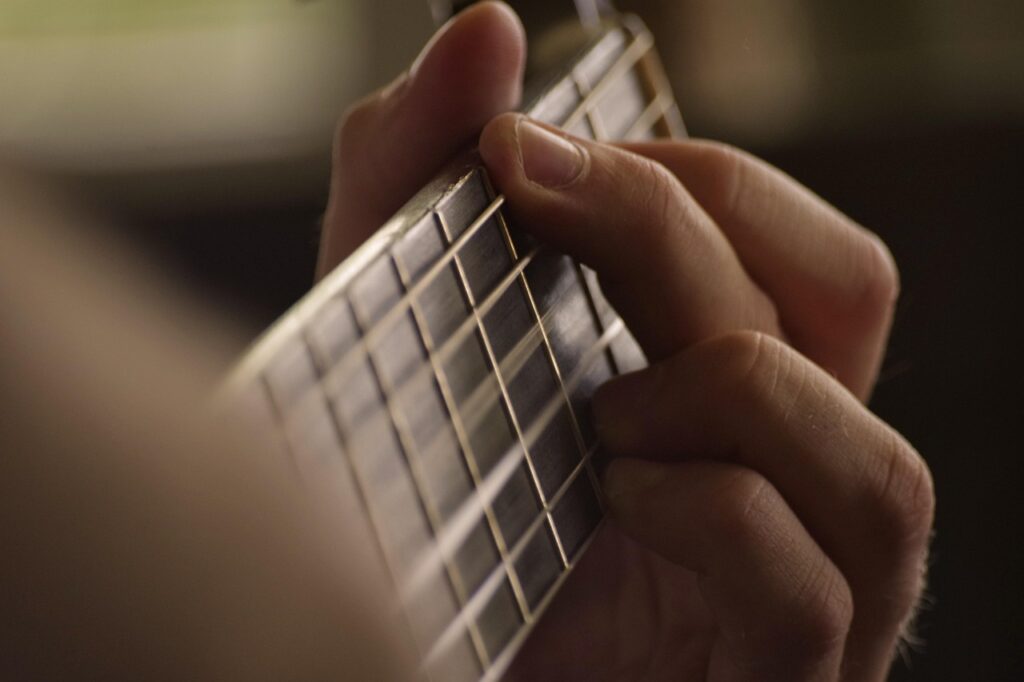
Practicing an instrument reveals something no productivity book ever quite manages to show: discipline isn’t willpower. It’s a way of paying attention.
There’s a scene familiar to anyone who has ever studied music. You’re sitting with your instrument, you’ve repeated the same passage ten times, and it still falls apart at the same spot. The temptation is to push through, pick up the tempo, play the whole piece as if momentum alone will fix things. Almost always, it doesn’t.
What works is something harder: stopping. Slowing down. Listening to exactly what’s coming out, not what you imagine is coming out.
That moment, small as it seems, holds one of the deepest lessons about discipline that life has to offer. And it rarely shows up in self-help books, productivity courses, or lists of habits shared by high performers. It lives in practice rooms, in music academies, in the quiet hours nobody else sees.
What Most People Mean by Discipline (and Why It Falls Short)
The popular version of discipline is pretty familiar. It shows up as resistance to instant gratification, waking up early when you’d rather not, doing the things you dislike because you know they’re necessary. In this view, discipline is fundamentally a battle against yourself, and victory belongs to whoever has the most willpower.
The problem with this definition is that it puts the focus entirely on effort. And raw effort, by itself, doesn’t take you anywhere particularly interesting.
A musician who practices five hours a day doing the same thing the same way doesn’t improve. They just reinforce their own mistakes more efficiently. The amount of time you put in is not what separates good from excellent. What separates them is the quality of attention brought to that time.
What the Research Actually Says
In 1993, psychologist Anders Ericsson and his colleagues conducted what would become a landmark study at the Music Academy of West Berlin. They divided violin students into three groups based on skill level: those considered elite, those considered good, and those most likely to pursue careers as music teachers. The central difference between the groups? Time devoted to deliberate practice, defined as activities specifically designed to maximize performance improvement.
The most accomplished musicians reported having accumulated, on average, around ten thousand hours of individual practice by early adulthood, far more than the less advanced groups. That data helped popularize the famous “ten-thousand-hour rule.” But the part that tends to get left out of the conversation is the most important one: simply accumulating ten thousand hours is not enough. Research shows that once a person reaches an acceptable level of performance, additional years of automatic, routine practice produce no meaningful gains.
What separates ordinary practice from deliberate practice isn’t duration. It’s presence.
Four Lessons Only Music Teaches
1. Repetition without attention isn’t practice. It’s just passing time.
Every serious musician learns early that mindlessly repeating a passage can be worse than not repeating it at all. When you execute something without paying attention, you’re training the mistake to stick. The muscle learns the wrong path and refuses to let go.
Musical discipline demands that each repetition be conscious. You listen to what just happened, compare it to what you intended, and adjust. It’s a continuous loop of attempt, observation, and correction. It’s much more tiring than simply playing through. And that’s exactly why it works.
The same logic applies to any skill. Writing every day without reading what you’ve written doesn’t make you a better writer. Training at the gym without paying attention to form doesn’t make you stronger. Real discipline is repeated attention, not automatic repetition.
2. A mistake is data, not a character flaw.
When you play a wrong note in front of an audience, it can be embarrassing. When you play it alone in the practice room, it’s information.
Serious musicians develop a strange relationship with mistakes: they go looking for them. They play slowly on purpose, precisely so the errors surface clearly. They don’t try to hide difficulty inside a faster tempo. They want to know exactly where the problem is, because that’s the only way to fix it.
Cellist Yo-Yo Ma, one of the most celebrated musicians in the world, has said that mastering music goes beyond learning technical skills, and that practicing is about quality, not quantity. Behind that statement is the understanding that every practice session is a conversation with your own limits. You don’t have it well if you’re on the defensive.
The transfer to everyday life is direct. In work environments, in personal projects, in relationships, the ability to treat a mistake as data rather than a verdict on your worth is one of the rarest and most valuable competencies there is.
3. Going slow isn’t lost time. It’s where real learning happens.
There is a technique universally taught in music education: when a passage is difficult, you play it slower than the target tempo. Sometimes much slower. The goal is to give the brain and muscles enough time to process each decision, each adjustment, each detail.
Most people do the opposite. When something is difficult, the instinctive response is to go faster, as if speed could dissolve the problem. At the piano, that doesn’t work. In life, it doesn’t either.
Many musicians, especially younger ones, fall into the trap of trying to play at full speed from the start. Speed without precision and control is useless. Clean execution at a slow tempo comes first. Speed follows naturally as a result.
Slowing down to learn is counterintuitive in a world that consistently confuses velocity with competence. But there’s a fundamental difference between doing something fast and doing something well. Music reminds you of that on a regular basis.
4. Playing for no one still counts. In fact, it’s what counts most.
Most of a musician’s work happens without an audience. The hours in a closed room, the exercise no one will ever hear, the passage repeated for the twentieth time on a quiet Tuesday afternoon. No likes, no applause, no immediate validation.
That teaches something essential: discipline that depends on an audience isn’t discipline. It’s a performance of discipline.
The musician who only practices before a concert, or who only studies when someone is watching, isn’t building anything solid. Real consistency is what happens in the dark, without witnesses, without immediate reward. It’s the practice that doesn’t show up anywhere, but holds up everything that does.
A Story That Brings It All Together
Warren Buffett is one of the most successful investors in history. What most people don’t know is that he has played the ukulele for decades. According to his son Peter, a professional musician, Buffett has played the instrument for years and famously used it to court his wife. He plays and sings at Berkshire Hathaway board meetings, charity events, and media appearances.
Buffett is not an exceptional musician. But he practices, he shows up, and he doesn’t play to impress. He plays because he enjoys it, because it fits his routine, because the practice itself holds value independent of the result.
There’s something quietly eloquent about that image: one of the wealthiest people in the world, who built his fortune on the discipline of long-term thinking, sitting with a small instrument, practicing without an audience, without any expectation of virtuosity. Just the practice, for what it is.
The Tension That Doesn’t Resolve (and Doesn’t Need To)
Music lives in a permanent tension between technique and expression. The more you master the technique, the more freedom you have for expression. But if you grip the technique too tightly, the expression disappears. If you neglect it, the expression is caged.
No musician resolves this paradox once and for all. They learn to inhabit it.
The discipline that music teaches isn’t the discipline of the robot, executing tasks without thinking. It’s the discipline of the craftsperson: present, attentive, capable of adjusting, of listening, of correcting, of starting again without drama.
That distinction matters deeply in the twenty-first century, when we’re constantly surrounded by systems that promise to automate, optimize, and accelerate everything. Technology can expand our capacity to do things. But it doesn’t replace the quality of attention we choose to bring to what we do.
How to Apply This Beyond Music
You don’t need to play an instrument to put these lessons to work. Three questions can help:
When you repeat something, are you listening to what’s coming out? Or are you just fulfilling the ritual of repetition, convinced that time spent is already enough?
How do you relate to mistakes in your field? Do they show up as threats to your self-image, or as useful data pointing you toward what needs work?
Can you do something well without an audience? Does your discipline survive the silence, the absence of metrics, the day when nobody is watching?
Discipline isn’t about doing more. It’s about being present in what you’re already doing.
Sometimes the most important lesson doesn’t come from a book about personal development. It comes from someone sitting on a bench, facing an instrument, playing the same passage one more time, with full attention, in no hurry to be done.